Stanford researchers did something no one in the AI industry wanted done. They read the privacy policies.
Not the marketing pages. Not the trust center FAQs. The actual legal documents governing how Amazon, Anthropic, Google, Meta, Microsoft, and OpenAI handle user data. Their findings, published as a peer-reviewed paper (King, Klyman et al., arXiv:2509.05382), confirm what every compliance officer suspected but could not prove:
All six vendors train on user chat data by default.
Every conversation. Every document you paste into a prompt. Every client name, case number, financial figure, and medical record that enters a cloud AI system becomes training material for the next version of the model. Not by accident. By design.
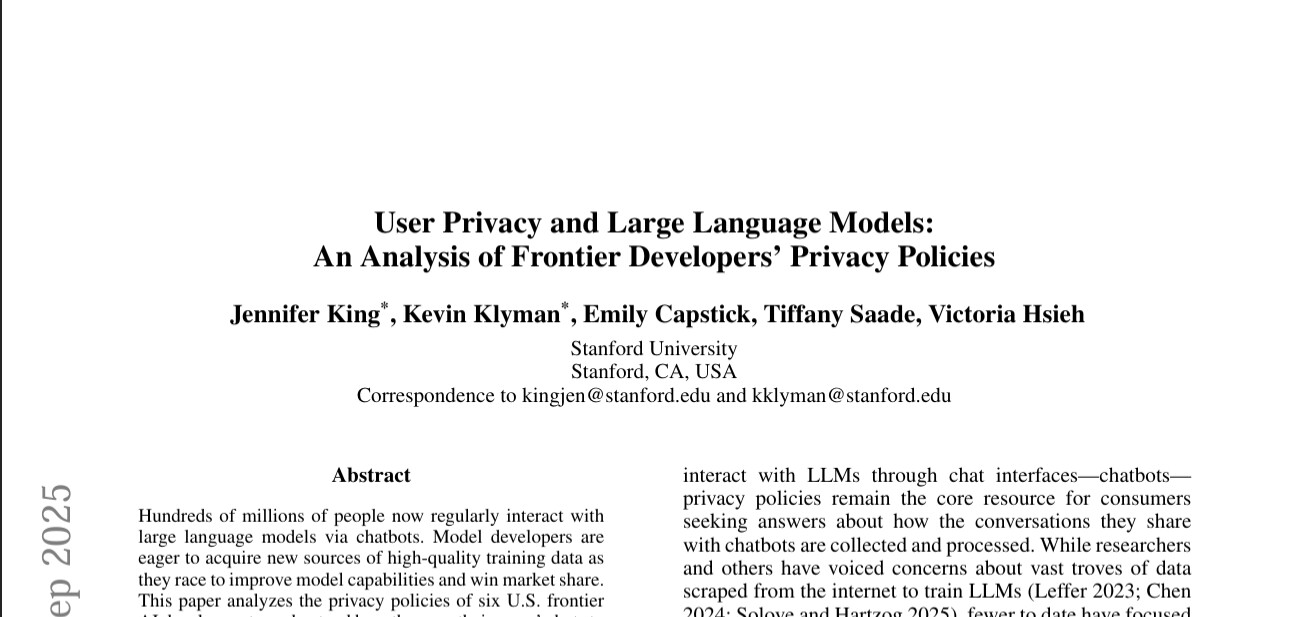
What Stanford found, vendor by vendor
The paper analyzed each vendor across five dimensions. Here is the full picture.
| Vendor | Trains by Default | Retention | Opt-Out | Human Reviewers | Child Data |
|---|---|---|---|---|---|
| Amazon | YES | Indefinite | Available | No | YES |
| Anthropic | YES | Limited | Switched to opt-out | No | No |
| YES | Limited | Available | YES | YES | |
| Meta | YES | Indefinite | Limited | No | YES |
| Microsoft | YES | Limited | Available | No | No |
| OpenAI | YES | Indefinite | Available | YES | YES |
The column that matters most: Trains by Default. All six. No exceptions.
Three vendors retain your data indefinitely: Amazon, Meta, OpenAI. Two employ human reviewers who read your actual conversations: Google and OpenAI. Four train on children's data.
The two-tier system
The paper reveals a structural divide in how AI vendors treat customers.
✓ Zero-retention clauses
✓ Dedicated infrastructure
✓ Custom BAAs negotiated
Requires: dedicated procurement, outside counsel review, enterprise-scale commitment
✗ Retention may be indefinite
✗ Shared infrastructure
✗ Human reviewers may read chats
This is where your 50-attorney firm, 15-physician practice, or CPA office sits.
The protections that enterprise customers negotiate are not available to smaller organizations by default. You get the same model. You pay a lower price. The difference is subsidized by your data.
What "opt-out" actually means
Anthropic is instructive. They launched Claude with opt-in training. Then in September 2025, the default flipped to opt-out. Users who had not explicitly opted in were now opted in unless they found the new setting. The policy you read when you signed up may not be the policy governing your data today.
Why enterprise-tier plans do not solve this
| Dimension | Enterprise Cloud Plan | On-Premise (Dhakma Core) |
|---|---|---|
| Training protection | Contractual promise | Physical impossibility |
| Data location | Vendor's global infrastructure | Your server room |
| Access control | Vendor's employee policies | Your IT team |
| Subpoena exposure | Vendor jurisdiction + yours | Your jurisdiction only |
| Audit capability | Vendor's compliance reports | Full hardware + network logs |
| Cost model | High minimum commitment | Fixed monthly cost |
| Vendor acquisition risk | New owner, new terms | Hardware you own |
A contractual promise is not the same as physical possession. For firms where the standard is physical control, enterprise cloud plans are insufficient.
What this means for regulated industries
| Industry | Governing Rule | What the Stanford Paper Proves | Consequence |
|---|---|---|---|
| Legal | ABA Model Rule 1.6(c) "Reasonable efforts" to prevent disclosure |
Default training + human review = unauthorized disclosure | Bar complaints, malpractice exposure |
| Medical | HIPAA Business Associate Agreements, minimum necessary |
Training on PHI violates minimum necessary standard | $141 to $2.13M per violation category per year |
| Finance | SEC Reg S-P, Rule 30(a) Fiduciary duty, safeguarding customer records |
Indefinite retention of client financial data | SEC enforcement, fiduciary breach |
| Defense | CMMC 2.0 / NIST 800-171 / ITAR Controlled Unclassified Information handling |
CUI in training sets, potential foreign national access via human review | ITAR violation, unauthorized export |
The pattern is the same across every vertical. The Stanford paper documents default data practices that are incompatible with the regulatory frameworks governing these industries. If your vendor trains on your data by default, and you cannot demonstrate otherwise to an auditor, you have a compliance problem.
The paper's own recommendation
The Stanford researchers propose five solutions. Number five is direct:
The attack surface is the network connection. Remove the connection, and the cloud training, retention, and human review risks documented in this paper cease to exist.
This is what Dhakma Core is
A sovereign AI appliance. Built to implement exactly what Stanford recommends.
The Stanford paper recommends on-device processing as a privacy safeguard. Dhakma Core implements it as a product. The gap between academic recommendation and operational capability is closed.
The exit is available now
Before this research, the argument for private AI was based on inference. Now it is based on documented evidence: all six vendors train on your data by default, and the policies ensure you cannot fully undo it.
The proof is published. Peer-reviewed. From Stanford.
The question is no longer whether cloud AI vendors train on your data. The question is how long your firm will continue to accept the risk.
Your intelligence. Sovereign. Your data never leaves the room. The cloud is absent by design.